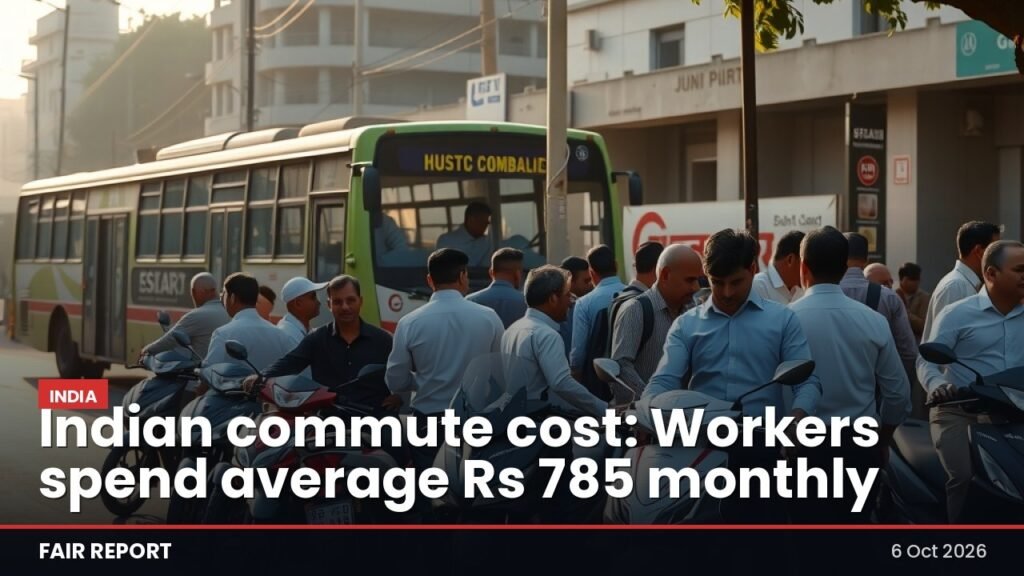
The latest government survey highlights the Indian commute cost faced by workers across the country. On average, the Indian commute cost sits at Rs 785 per month for employees traveling to a fixed workplace.
Key takeaways
- Average monthly commute expense: Rs 785.
- Urban workers pay about Rs 1,044 per month.
- Rural workers pay about Rs 612 per month.
- Two‑wheelers are the most common mode for fixed‑workplace travel.
- Higher transport costs squeeze household budgets.
Indian commute cost by region
Released on 5 October 2026, the survey divided respondents into urban and rural groups. Urban commuters said they spend about Rs 1,044 each month, whereas rural commuters reported Rs 612. These figures reflect the differing infrastructure, fuel price exposure, and congestion levels across India’s diverse landscape.
Beyond the simple urban‑rural split, the data shows that metro cities such as Mumbai, Delhi, and Bengaluru have slightly higher averages, while smaller towns in states like Madhya Pradesh and Odisha hover closer to the rural figure. This regional nuance is important for policymakers aiming to tailor subsidies or improve public transport in high‑cost zones.
Urban versus rural expenses
City traffic is heavier and fuel costs higher, which pushes the price gap. Many city workers find the expense takes a bigger bite out of their take‑home pay than villagers do. In addition, urban commuters often rely on two‑wheelers or private cars to navigate congested streets, whereas rural workers may travel longer distances on buses or shared autos, which can be cheaper per kilometre but still add up due to distance.
Urban commuters also tend to face higher parking fees and toll charges, especially on expressways that connect suburbs to central business districts. Rural commuters, while traveling farther, benefit from lower vehicle maintenance costs and fewer tolls, balancing the overall spend.
| Location | Average monthly cost (Rs) |
|---|---|
| Urban | 1,044 |
| Rural | 612 |
Preferred mode of transport
Motorcycles and scooters topped the list as the go‑to rides for workers heading to a fixed job. Buses and shared auto‑rickshaws came in second. Two‑wheelers dominate because they are affordable, fuel‑efficient, and can weave through traffic more easily than four‑wheelers.
Public transport usage varies widely. In cities with robust metro networks, such as Delhi and Kolkata, a growing segment of commuters now relies on trains and metro lines, reducing their dependence on personal vehicles. However, in many tier‑2 and tier‑3 cities, bus services remain the backbone of daily travel, often operating on irregular schedules that push commuters toward private two‑wheelers.
Impact on household budgets
Spending close to the average Rs 785 on travel each month can chew into savings and curb spending on basics. The survey says transport costs are becoming a bigger worry for low‑ and middle‑income families, especially when wages stagnate and fuel prices rise.
For many households, the commute expense represents 5‑10 % of total monthly income, a proportion that can force trade‑offs between education, healthcare, and nutrition. When transport costs spike, families may delay or forego essential purchases, highlighting the broader socioeconomic ripple effect of the Indian commute cost.
Practical steps for commuters
Workers can try car‑pooling, employer shuttles, or flexible work‑from‑home setups when possible. Picking routes that dodge rush hour also helps cut fuel use. In addition, using fuel‑efficient two‑wheelers, maintaining proper tyre pressure, and planning trips to combine errands can shave a few rupees off the monthly bill.
Employers can play a role by offering subsidised public‑transport passes, setting up dedicated parking for carpools, or providing on‑site childcare to reduce the need for multiple trips. Such initiatives not only lower the Indian commute cost for employees but also improve overall productivity.
Factors influencing Indian commute cost
Several macro‑level factors drive the numbers observed in the survey. Fuel price volatility remains a primary driver; even a modest rise in petrol or diesel prices can increase monthly spend by 10‑15 %. Vehicle depreciation, insurance premiums, and routine maintenance also add hidden costs that many commuters overlook.
Infrastructure quality plays a crucial role. Poor road conditions increase fuel consumption and vehicle wear, while inadequate public‑transport coverage forces commuters onto costlier private modes. Seasonal variations, such as monsoon‑related traffic snarls, can further inflate travel time and fuel usage.
Finally, demographic trends—such as the rise of gig‑economy workers who often lack employer‑provided transport benefits—contribute to a higher average Indian commute cost for younger, urban professionals.
Policy implications and government initiatives
Understanding the Indian commute cost is essential for shaping effective transport policy. The Ministry of Road Transport and Highways has launched the National Transport Policy aimed at expanding affordable public‑transport options, especially in underserved rural corridors.
State governments are also experimenting with subsidies for electric two‑wheelers, which promise lower operating costs over the vehicle’s lifespan. The Urban Mobility Initiative in Delhi, for example, integrates metro, bus, and bike‑share services into a single payment platform, simplifying fare structures and encouraging multimodal travel.
These policy levers can directly reduce the average Indian commute cost, easing pressure on household budgets and supporting broader economic growth.
Future trends and technology
Emerging technologies are poised to reshape how Indians commute. Ride‑hailing platforms like Uber and Ola are expanding shared‑ride options that split costs among passengers, while electric scooters are gaining market share due to lower running costs and government incentives.
Smart‑city projects are deploying real‑time traffic management systems that optimise signal timings, potentially reducing congestion‑related fuel waste. In the longer term, autonomous shuttles and high‑speed rail corridors could dramatically lower the Indian commute cost for long‑distance commuters.
Regional variations beyond urban/rural
While the survey’s primary split is urban versus rural, deeper analysis reveals sub‑regional disparities. For instance, commuters in the National Capital Region (NCR) report average costs exceeding Rs 1,200 due to premium parking fees and tolls, whereas workers in the Himalayan foothills often spend less than Rs 500 because of shorter distances and reliance on walking or cycling.
These nuances suggest that a one‑size‑fits‑all approach to transport subsidies may be insufficient. Targeted interventions—such as toll waivers for low‑income commuters in high‑cost corridors—could be more effective.
Extended tips for reducing Indian commute cost
Beyond basic car‑pooling, commuters can explore the following strategies:
- Leverage employer‑provided transit passes: Many large firms partner with local transit authorities to offer discounted monthly passes.
- Adopt a multimodal commute: Combining a short bike ride with a bus or metro leg can cut fuel expenses and improve health.
- Utilise off‑peak travel: Some cities offer lower fares during non‑peak hours, which can be especially beneficial for flexible‑hour workers.
- Maintain vehicle efficiency: Regular servicing, timely oil changes, and using the recommended octane fuel can improve mileage by up to 12 %.
- Explore government rebates: Check the commuter benefits portal for subsidies on electric vehicle purchases or public‑transport vouchers.
By adopting a combination of these measures, Indian workers can bring their monthly commute expense closer to the national average of Rs 785, freeing up income for savings, education, and other essential needs.
FAQ
How much do Indian workers spend on commuting each month?
The government survey found an average monthly spend of Rs 785 per worker.
What is the cost difference between urban and rural commuters?
Urban workers average Rs 1,044 per month, while rural workers spend about Rs 612.
Which mode of transport is most common for commuting to a fixed workplace?
Two‑wheelers, such as motorcycles and scooters, are the most frequently used mode.
How does commuting expense affect household budgets?
Higher travel costs reduce disposable income, limiting savings and spending on essentials, especially for low‑ and middle‑income families.
What can commuters do to reduce their travel costs?
Car‑pooling, employer shuttles, flexible remote work and avoiding peak traffic can help lower expenses.
Sources
- Daily Excelsior: Indian workers spend average Rs 785 monthly to reach office: Govt survey
- MillenniumPost: Indian workers spend avg `785/month to reach office: Survey
- The Times of India: Indian workers spend Rs 785 monthly on commute; urban travel cost to office 70% higher: Govt survey
- Sambad English: 2-wheelers emerge as key commute mode for fixed workplaces; workers spend ₹785 monthly on average: NSO