Escalating its legal offensive against the Election Commission ahead of Tuesday’s crucial Supreme Court hearing, the Opposition has demanded sworn, individual affidavits from CEC Gyanesh Kumar and the two Election Commissioners – asking who ordered the voter roll revision, whether internal dissents were buried, and if private vendors altered the electoral database.
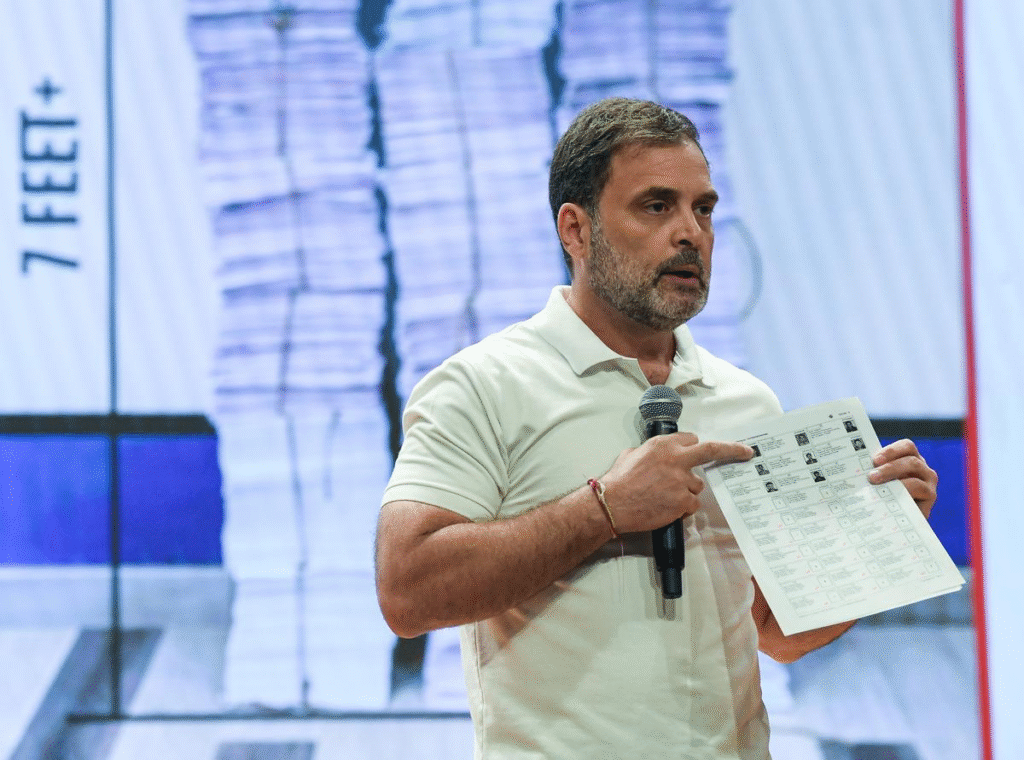
NEW DELHI : Seeking to pierce the Election Commission of India’s (ECI) claim of collective consensus, Leader of the Opposition Rahul Gandhi and top INDIA bloc leaders on Monday moved the Supreme Court for permission to serve a piercing set of 48 interrogatories on the poll panel over the contentious Special Intensive Revision (SIR) of electoral rolls.
In a sharp rejoinder filed ahead of Tuesday’s hearing before a bench led by Chief Justice of India Surya Kant, the Opposition directly challenged the ECI’s October 26 counter-affidavit, which had maintained that all decisions concerning the nationwide voter list revision were taken unanimously.
”An assertion of unanimity is not proof of it,” the petitioners contended, pointing out that the poll body failed to produce a single piece of primary evidence—no meeting minutes, agenda papers, or file notings—to prove that Chief Election Commissioner (CEC) Gyanesh Kumar and Election Commissioners Sukhbir Singh Sandhu and Vivek Joshi had acted in concert.
Piercing the veil of consensus
Turning the spotlight squarely on the internal dynamics of Nirvachan Sadan, the Congress-led bloc demanded that if the Deputy Election Commissioner lacks official records to answer the 48 questions, CEC Gyanesh Kumar and Commissioners Sandhu and Joshi must file separate, sworn affidavits detailing their individual stands.
Among the sharpest queries aimed at the poll body:
The missing paper trail: When and how did the three-member Commission approve the October 26 affidavit—was a formal meeting held, or was consent secured via electronic means?
Who pulled the trigger: On what exact date did the Commission decide to roll out the SIR nationwide, and which official file records that decision?
Buried dissent: How many times between February 19, 2025, and October 26, 2026, did Election Commissioners Sandhu and Joshi record written objections, and were key SIR decisions pushed through by a majority rather than consensus?
Database integrity: Since June 24, 2025, has any employee of a private vendor or contractor been granted authority to enter or alter data in the voter list database, and who authorised unapproved alterations to the online Form 6 portal?
For the Congress and its allies, the legal battle is central to a broader political charge of systematic disenfranchisement and “vote chori”. Alongside Gandhi and Congress president Mallikarjun Kharge, the petition is backed by a united Opposition front including leaders from the TMC, Samajwadi Party, RJD, Shiv Sena (UBT), NCP (Sharad Pawar), DMK/VCK, JMM, and the Left.
By pressing the Supreme Court to preserve internal file notings and ERONET/ECINET access logs—a plea argued by senior advocate Abhishek Manu Singhvi during the previous hearing-the Opposition is seeking to establish that unilateral executive action overshadowed statutory due process during the roll revision, allegedly leading to large-scale exclusions of poor, Dalit, minority, and migrant voters.
The standoff traces back to mid-October, when Opposition MPs marched from Barakhamba Road to the Supreme Court after being denied an appointment with the CJI, prompting Justice Surya Kant to remark during the October 15 hearing that no one could intimidate or pressure the court. Nevertheless, the bench issued notices to the ECI and all three Commissioners, later granting the Opposition time to respond to the poll panel’s 250-page defense.
With the Supreme Court set to take up the matter on Tuesday, November 17, the bench’s decision on whether to allow the 48 questions will determine if the Election Commission’s internal deliberations are opened up to judicial and public scrutiny.