



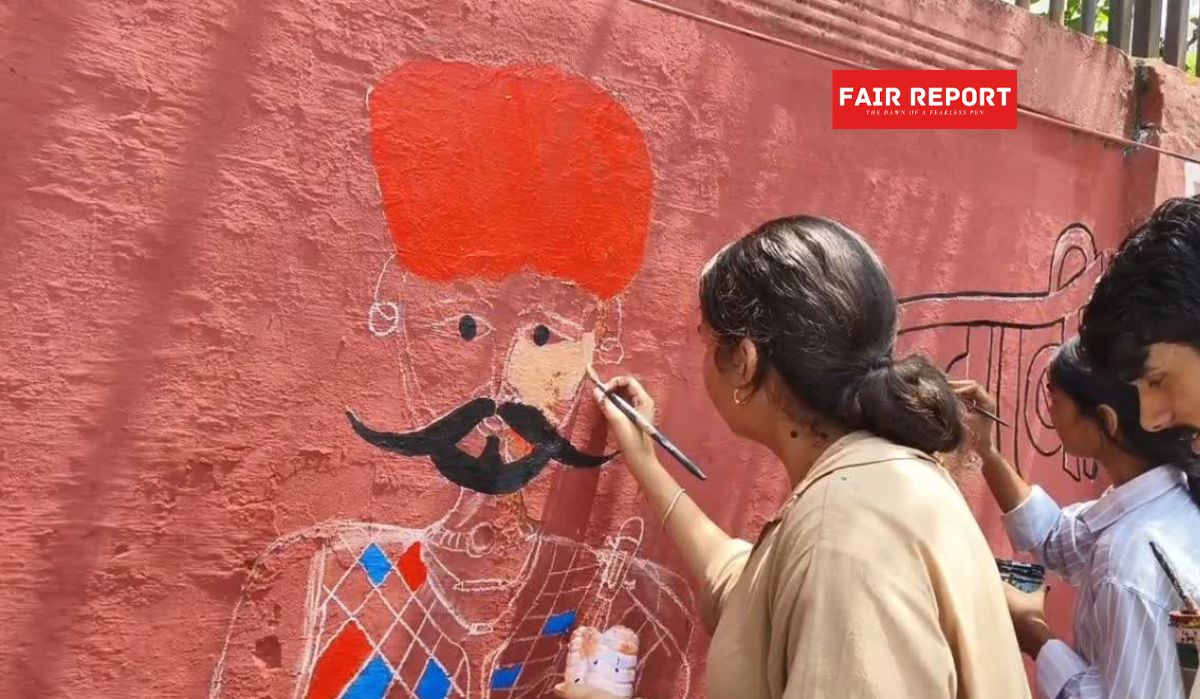
Jaipur news today: Jaipur. A newly painted “Dream Big Work Hard” mural, created under the Jaipur Nagar Nigam civic beautification initiative, has drawn attention online after a video showed schoolchildren filming and taking selfies near a wall reportedly featuring a large collage of Hindu deities.
The mural forms part of the Jaipur Nagar Nigam’s ongoing urban beautification and wall-art programme, which aims to transform public infrastructure—boundary walls, flyovers, and school surroundings—into visually engaging spaces carrying motivational messages, cultural motifs, and heritage-inspired artwork. The initiative is designed to promote civic awareness, reduce visual clutter, and enhance the aesthetic identity of the city.
In this case, the mural combines a contemporary motivational slogan, “Dream Big Work Hard,” with layered religious and cultural imagery, making it both visually striking and, for some observers, interpretatively complex.
The video circulating on social media has triggered discussion around whether such installations should be viewed purely as civic art or as cultural-religious expressions embedded in public space. While some argue that the mural reflects Jaipur’s traditional-cultural continuity within a modern aspirational framework, others have raised concerns about the contextual placement of sacred imagery in a setting increasingly used as a backdrop for social media content.
The presence of schoolchildren recording the wall has further amplified the discourse, highlighting how public art in the digital era often transitions rapidly from civic messaging to viral visual content.
Critics of the trend say that repeated use of religious or cultural symbolism in decorative public installations risks diluting their sanctity when reduced to aesthetic elements. Supporters, however, maintain that such murals are reflective of Jaipur’s layered identity, where civic messaging, spirituality, and public expression frequently intersect.
The episode underscores a broader shift in urban visual culture: under initiatives like those of Jaipur Nagar Nigam, public art is no longer static communication—it becomes dynamic, participatory, and instantly reinterpreted through the lens of social media