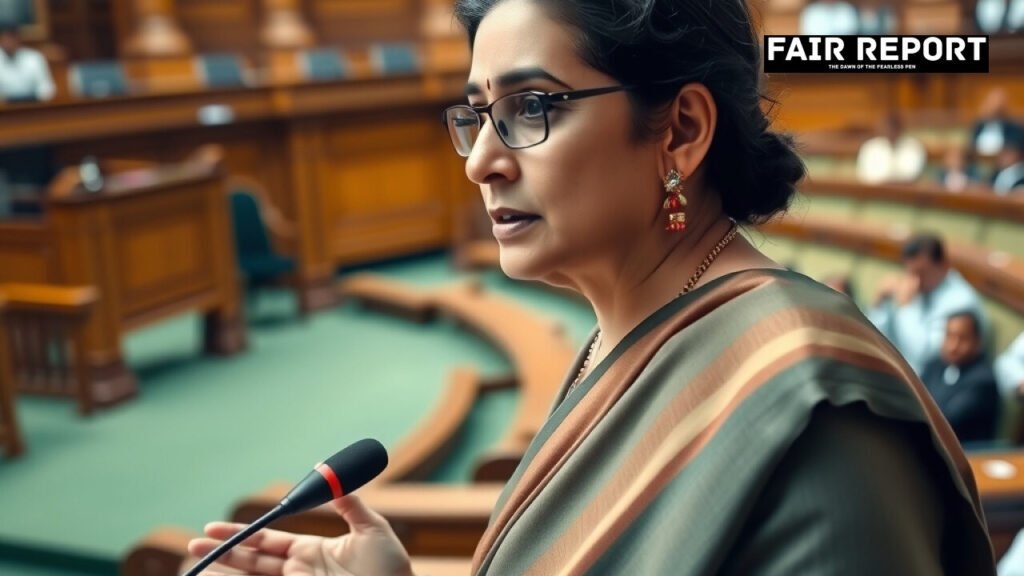
Rahul Gandhi debate challenge to Prime Minister Narendra Modi has moved from social media to the floor of the Lok Sabha. Finance Minister Nirmala Sitharaman answered the call, insisting that Parliament is already the venue for any substantive exchange.
Key takeaways
- Gandhi demanded an open debate with Modi on alleged governance failures.
- Sitharaman urged him to present evidence inside Parliament.
- Both leaders framed the issue as a question of parliamentary procedure.
- The exchange highlights the opposition’s strategy of using the legislature to press the government.
Rahul Gandhi debate challenge gains response
On 3 November 2026, Rahul Gandhi posted a direct challenge to Prime Minister Modi, asking for a public, evidence‑based discussion on several policy matters. He suggested that a televised debate could settle doubts about the government’s record.
Finance Minister Nirmala Sitharaman, speaking to reporters, rejected the notion of a separate media forum. “Parliament is already the venue,” she said, adding that Gandhi should bring any allegations to the House and stay there to hear the government’s response.
Sitharaman’s procedural reminder
Sitharaman’s remarks echoed a broader stance by the ruling party that parliamentary privilege, not social‑media sparring, should settle disputes. She referenced a similar invitation from Home Minister Amit Shah, who earlier urged Gandhi to debate the Security of India (SIR) and electronic voting machine (EVM) issues within the legislature.
“If you have evidence, present it in the Lok Sabha and let the opposition and the government discuss it on record,” Sitharaman said.
Opposition’s perspective
The Congress leader argued that a live, open forum would reach a wider audience and hold the government to account beyond the confines of parliamentary debates, which he claims are often “controlled”. He did not specify a date or format for such a debate.
Critics of the government have repeatedly pointed to alleged irregularities in procurement, tax policy, and electoral processes, but have not yet produced documentary proof in the House.
Parliamentary norms and past precedents
India’s parliamentary tradition allows for pointed questions, motions, and debates on policy. Historically, opposition leaders have used the Question Hour and special debates to press the executive.
When disputes arise, the Speaker can schedule a special debate if a minimum number of members support it. No such motion has been filed yet regarding Gandhi’s challenge.
“Parliament is already the venue,” Finance Minister Nirmala Sitharaman said.
What comes next?
For the challenge to become a formal debate, Rahul Gandhi or another Congress member must file a motion in the Lok Sabha. The Speaker will then decide whether to allocate time.
The government’s stance keeps the discussion within parliamentary procedures, where the ruling party holds a majority.
Citizens interested in following the development should monitor the Lok Sabha’s agenda and any statements from the Congress leadership in the coming weeks.
Historical context of televised debates in Indian politics
Televised debates between senior politicians are not new in India, but they have rarely been institutionalised. The most notable example was the 2014 debate between then‑Prime Minister Narendra Modi and opposition leader Rahul Gandhi on national television, which attracted record viewership and set a precedent for direct public engagement. That debate, however, was arranged by a private broadcaster and not by the Parliament itself, leading to mixed opinions about its impact on legislative accountability.
Since then, several state assemblies have experimented with live broadcasts of question periods, but the Lok Sabha has maintained a more restrained approach, preferring formal motions and recorded proceedings. Analysts argue that a formal televised debate inside the parliamentary chamber could enhance transparency while preserving procedural integrity.
Political implications for the ruling party
The ruling Bharatiya Janata Party (BJP) has consistently framed challenges from the opposition as attempts to destabilise the government. By directing the debate to the parliamentary floor, the party seeks to control the narrative, limit media sensationalism, and ensure that any discussion occurs under the strict rules of parliamentary privilege.
Senior BJP strategist Amit Shah has warned that ad‑hoc media events can be “weaponised” by opponents, diverting attention from policy implementation. This viewpoint aligns with Sitharaman’s insistence that evidence must be presented on record, where it can be examined by all members and the Speaker.
Potential impact on public opinion
Public opinion polls conducted after the initial challenge indicated a split response. A BBC report noted that 48% of respondents favoured a televised debate, believing it would increase accountability, while 42% trusted the parliamentary process to handle the issue adequately.
Media analysts suggest that the eventual format—whether a formal parliamentary debate or a televised event—will shape voter perceptions ahead of the next general election. A well‑documented parliamentary exchange could reinforce the image of a functioning democracy, whereas a televised showdown might energise younger voters seeking direct engagement.
Legal and constitutional considerations
India’s Constitution does not prescribe a specific venue for political debates, but it does guarantee freedom of speech within the confines of parliamentary privilege. The Supreme Court has ruled that statements made on the floor of the House enjoy protection from defamation suits, underscoring the importance of the parliamentary arena as a safe space for robust discussion.
Any attempt to move the debate to a media platform would raise questions about the applicability of these protections and could set a precedent for future disputes. Legal scholars caution that bypassing Parliament might erode the balance between legislative oversight and executive authority.
Future scenarios
If a motion is filed and approved, the debate could be scheduled during a special session, allowing both leaders to present evidence, cross‑examine each other, and respond to questions from other members. Such a session would be broadcast live on the official Lok Sabha website, ensuring public access while retaining procedural safeguards.
Alternatively, if the opposition persists in demanding a separate televised forum, the government may consider a joint press conference or a moderated debate hosted by a neutral agency. This hybrid approach could satisfy public demand for transparency while preserving parliamentary primacy.
Regardless of the format, the episode underscores the evolving relationship between Indian politics, media, and democratic institutions. It also highlights the strategic calculus of both the opposition and the ruling party as they navigate the expectations of an increasingly digital electorate.
FAQ
What did Rahul Gandhi ask for?
He asked Prime Minister Narendra Modi to engage in an open, evidence‑based debate on the government’s policies.
How did Nirmala Sitharaman respond?
She told Gandhi to bring any allegations to Parliament, saying the House is already the proper venue for such a discussion.
Can a debate be scheduled in Parliament?
Yes, if a member files a motion and secures enough support, the Speaker can allocate time for a special debate.
Has a similar request been made before?
Home Minister Amit Shah previously invited Gandhi to debate the SIR and EVM issues within Parliament.
Where can the public follow this issue?
Updates will appear in the Lok Sabha’s official agenda and in statements from the Congress and BJP leadership.