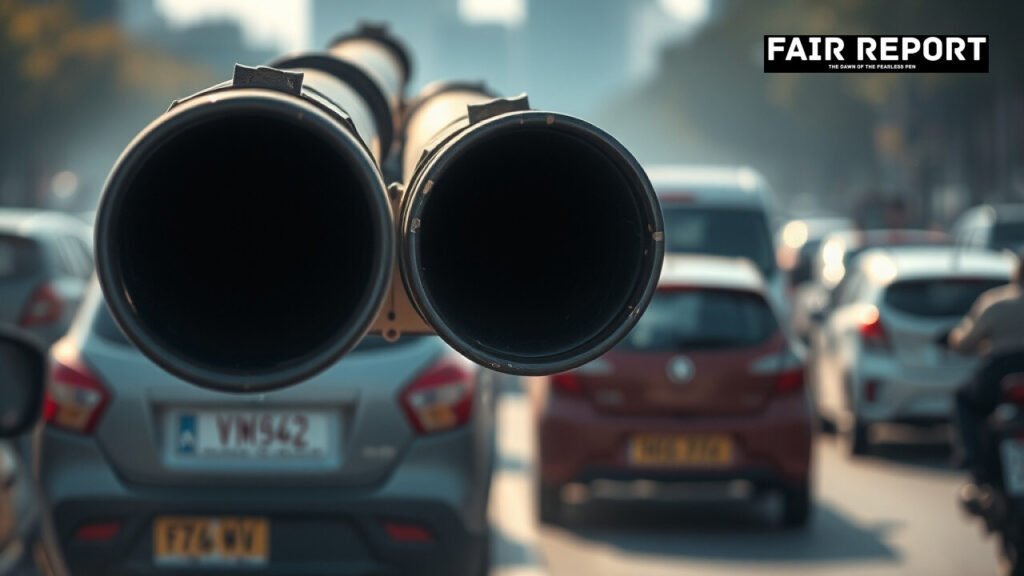
The Supreme Court of India has identified vehicular emissions as a primary contributor to severe Delhi air pollution, sharply criticizing the unmonitored surge of motor traffic across the National Capital Region. Expressing deep concern over deteriorating air quality index (AQI) levels in hearings on November 6 and 7, 2026, the top court described the traffic situation on the capital’s roads as an unmanaged “free-for-all.”
Key Takeaways
- Supreme Court flags vehicular emissions as a major cause of escalating Delhi air pollution.
- Chief Justice points out that traffic management in Delhi has become a “free-for-all” situation.
- The bench emphasizes that economically disadvantaged residents suffer the worst consequences of toxic air.
- To control stubble burning, the court directed authorities to provide financial incentives and alternatives to farmers.
- Judges suggested state procurement agencies directly buy crop residue (parali) from farmers.
Supreme Court Flags Vehicular Emissions in Delhi Air Pollution Crisis
During the proceedings, the Supreme Court focused squarely on vehicular emissions, identifying them as a dominant force driving the region’s environmental hazard. The bench questioned why air quality levels continue to climb despite repeated administrative directives and seasonal emergency plans. Pointing to congested thoroughfares across Delhi and neighboring urban centers, the judges remarked on the sheer volume of automobiles operating without effective regulation.
Chief Justice of India directed attention to everyday traffic conditions, telling counsel to “look at the roads” to understand the scale of motor exhaust entering the atmosphere. The court noted that traffic management in Delhi-NCR appears to operate in a state of chaos, where vehicular volume grows unchecked, directly exacerbating the haze hovering over the region each winter. Rather than treating toxic smog strictly as a seasonal agricultural problem, the court insisted that year-round vehicular exhaust must be recognized as a central cause of Delhi air pollution.
Vehicular exhaust contains high concentrations of fine particulate matter, oxides of nitrogen, and volatile organic compounds. When these pollutants combine with stagnant atmospheric conditions during late autumn, they form dense smog that lingers low over the city. The top court pointed out that without strict enforcement against idling vehicles, non-compliant diesel engines, and severe traffic gridlock, emergency measures alone would fail to yield long-term clean air.
Disproportionate Toll on Vulnerable Populations
Highlighting the human impact of the crisis, the Chief Justice observed that poor people are the primary sufferers of deteriorating air quality. While affluent residents can retreat indoors behind air purifiers, millions of outdoor laborers, daily wage earners, street vendors, and public transport commuters remain continuously exposed to dangerous ambient air.
The court expressed concern that rising AQI numbers directly translate into acute respiratory illness, reduced life expectancy, and crippling healthcare costs for families least equipped to handle them. The justices observed that prolonged exposure to high pollution levels infringes on the basic right to health, leaving underprivileged communities vulnerable every time air quality enters the severe category.
The bench questioned state officials on why preventive measures are repeatedly delayed until toxicity reaches hazardous thresholds. Judges observed that public health advisories to stay indoors carry little meaning for individuals who must work outside daily to earn a living, reinforcing the need for systemic court-monitored interventions.
Stubble Burning and Economic Incentives for Farmers
Addressing the secondary major contributor to regional smog—stubble burning or parali burning in neighboring agrarian states—the Supreme Court emphasized that punitive actions alone against farmers are insufficient. Instead, the court urged governments to establish sustainable economic incentives and practical alternatives that make crop residue management viable for small landholders.
The court proposed that state procurement agencies step forward to purchase crop residue directly from farmers. By creating a commercial market for crop stubble, state governments could encourage agricultural workers to harvest parali for industrial use, biomass power, or animal fodder rather than setting fields ablaze.
The justices noted that farmers often face tight planting windows between harvesting paddy and sowing wheat, leaving them minimal time and limited machinery to clear fields manually. Providing financial compensation, subsidized harvesting machinery, and guaranteed government buyback programs would align environmental goals with agricultural economics, systematically curbing seasonal fires that compound Delhi air pollution.
Data Breakdown: Key Contributors to Delhi Air Quality
| Pollution Sector | Identified Issue | Supreme Court Recommendation |
|---|---|---|
| Vehicular Emissions | Unchecked traffic density, idling, and high diesel exhaust | Strict enforcement, traffic management, and tailpipe checks |
| Stubble Burning (Parali) | Seasonal field burning due to cost and tight crop cycles | Economic incentives, machinery access, and state procurement |
| Urban Air Quality (AQI) | Consistently high AQI levels harming public health | Targeted interventions focused on protecting vulnerable groups |
Enforcement Deficits Across the Capital Region
A recurring theme during the Supreme Court hearing was the lack of coordinated enforcement among municipal authorities, traffic police, and environmental monitoring boards across Delhi, Haryana, Uttar Pradesh, and Punjab. The court expressed dissatisfaction with fragmented jurisdictional responses, where policies adopted in one district are neglected in adjacent areas.
Despite heavy restrictions on commercial trucks entering the capital and rules mandating valid Pollution Under Control (PUC) certificates, enforcement on the ground remains spotty. The top court pointed out that failure to monitor commercial freight corridors and heavy urban bottlenecks renders clean air policies ineffective in practice.
The judges instructed state administrations to streamline inter-departmental efforts, ensuring that traffic control measures actively target pollution hotspots and major arterial roads. Without continuous enforcement and joint coordination across state boundaries, seasonal spikes in Delhi air pollution will continue to recur annually.
Policy Roadmap and Next Steps for Clean Air
Moving forward, the Supreme Court’s intervention signals a shift toward holding administrative authorities accountable for long-term urban planning and environmental compliance. State governments and municipal authorities are expected to present actionable blueprints detailing how traffic density will be managed and how crop residue procurement will be executed in upcoming seasons.
As judicial oversight intensifies, the emphasis remains firmly on translating policy declarations into clean, breathable air on the ground.
Frequently Asked Questions
What did the Supreme Court identify as the major cause of Delhi air pollution?
The Supreme Court flagged vehicular emissions as a primary contributor to Delhi's air pollution, pointing out that unchecked traffic on roads creates an unmanaged congestion crisis.
What solutions did the court suggest for stubble burning?
The court recommended providing farmers with economic incentives, practical alternatives, and direct procurement of crop residue (parali) by state agencies.
Who did the Chief Justice say suffers the most from Delhi pollution?
The Chief Justice observed that poor people and outdoor workers bear the heaviest burden of severe air pollution as they cannot easily protect themselves from toxic ambient air.