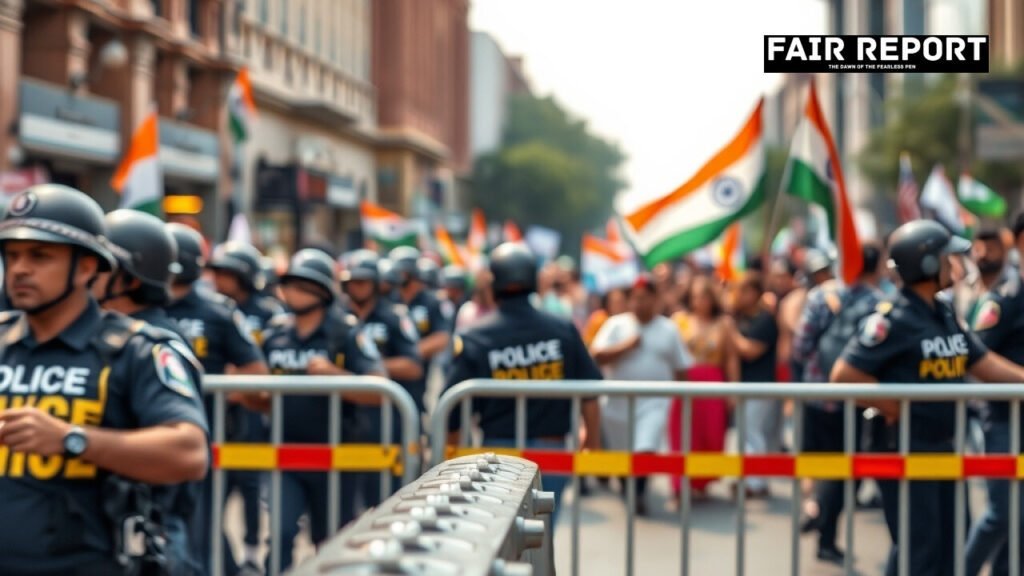
CJP Connaught Place Protest is set to become a focal point of Delhi’s civic discourse as the court’s recent ruling permits the demonstration to proceed on October 16. The decision, delivered by the Delhi High Court, underscores the delicate balance between the right to peaceful assembly and the state’s responsibility to maintain public order. As the date approaches, organizers, law enforcement agencies, and ordinary citizens are closely watching how the protest will unfold in the bustling heart of the capital.
Key Takeaways
- The Delhi High Court has refused to stop the CJP Connaught Place Protest.
- The police have assured to regulate the event.
- The protest is scheduled to take place on October 16.
CJP Connaught Place Protest: Court Decision
The court’s refusal to issue an injunction came after a petition argued that the protest could jeopardise law and order in one of Delhi’s most crowded commercial zones. While the petition highlighted concerns about traffic disruption, potential clashes, and the safety of nearby businesses, the bench concluded that the constitutional right to protest outweighs speculative threats, provided that adequate police measures are in place.
Background
The CJP Connaught Place Protest has been a topic of discussion in recent days, with many raising concerns about the potential disruption to law and order. The Delhi High Court’s decision to refuse the plea to restrain the protest has been seen as a significant development in the matter.
Police Regulation
The police have assured to regulate the event, with measures in place to ensure that the protest does not disrupt law and order. The police have also stated that only 11 people will be allowed to carry flags during the protest.
CJP Connaught Place Protest: Police Strategy
Police officials have outlined a multi‑layered strategy that includes crowd‑control personnel stationed at key entry points, real‑time monitoring through CCTV, and a rapid‑response team ready to intervene should any untoward incident arise. Vehicles will be rerouted around the protest zone, and public transport operators have been instructed to provide alternative routes for commuters.
Reaction
The reaction to the Delhi High Court’s decision has been mixed, with some welcoming the move and others expressing concerns about the potential consequences. The CJP has stated that the protest will go ahead as scheduled, despite the concerns raised by some.
Public Opinion
Social media platforms are buzzing with opinions. Supporters argue that the CJP Connaught Place Protest is a legitimate expression of dissent, while critics worry about the impact on local businesses and daily commuters. Several resident welfare associations have appealed to the authorities for clear communication regarding road closures and safety protocols.
Legal Background
Indian jurisprudence has long upheld the right to peaceful assembly under Article 19(1)(a) of the Constitution, subject to reasonable restrictions in the interest of sovereignty, security, and public order. The Delhi High Court referenced precedents such as *Shreya Singhal v. Union of India* and *Arun Kumar v. State of Bihar* to justify its stance, emphasizing that the state must facilitate, not stifle, lawful protest.
Police Preparations
In preparation for the CJP Connaught Place Protest, the Delhi Police have conducted mock drills, coordinated with municipal authorities, and issued detailed guidelines to protest organizers. These guidelines cover the number of participants, permissible signage, noise levels, and the prohibition of any incendiary devices. The police have also set up medical aid stations and designated evacuation routes.
Potential Impact
If the protest proceeds without major incidents, it could set a precedent for future demonstrations in high‑traffic urban areas. Conversely, any breach of the agreed‑upon regulations could prompt stricter enforcement measures in subsequent events, potentially reshaping the legal landscape surrounding public assemblies in India.
What’s Next
The protest is scheduled to take place on October 16, and it remains to be seen how the event will unfold. The police have assured to regulate the event, and it is likely that the protest will be closely monitored by the authorities.
Conclusion
The CJP Connaught Place Protest stands at the intersection of constitutional rights and public safety. As Delhi prepares for the demonstration, the collaborative effort between organizers, law enforcement, and the judiciary will be crucial in ensuring that the protest remains peaceful, orderly, and within the bounds of the law. The outcome will not only affect the immediate participants but also influence how future protests are managed in India’s bustling metropolitan centres.
Frequently Asked Questions
What is the CJP's protest at Connaught Place about?
The CJP's protest at Connaught Place is scheduled to take place on October 16, but the exact details of the protest are not clear.
Why did the Delhi High Court refuse to stop the protest?
The Delhi High Court refused to stop the protest after the police assured to regulate the event.
What measures will the police take to regulate the event?
The police have stated that only 11 people will be allowed to carry flags during the protest, and other measures will be in place to ensure that the protest does not disrupt law and order.
Sources
- NDTV: Delhi High Court Refuses To Stop CJP's Connaught Place Protest. Police To 'Regulate'
- News Mobile: Delhi HC Records Police Assurance on CJP’s Proposed Protest
- ANI News: Delhi HC records police assurance of legal measures ahead of CJP’s proposed Connaught Place protest
- The Hindu: Delhi High Court declines plea against CJP’s October 16 protest at Connaught Place
- NDTV: Don't Join, Will Allow Only 11 Carrying Flag: Delhi Police On CJP's Connaught Place Protest